Defensive Fund-Managing funds during uncertain times


The world has seen four decades of broadly declining interest rates, which has helped stock market returns. By definition, low interest rates meant low returns from fixed interest assets. We are now seeing unprecedented, concerted efforts by central banks globally to raise interest rates. While we had ultra-low interest rates, huge money was thrown at questionable “investments” like NFT’s (non-fungible tokens) and cryptocurrencies.
Recently, major UK pension funds (which had derivative positions to protect them against interest rate moves) lost significant amounts when interest rates rose, forcing them to dump bonds at a loss in order to raise cash to meet margin calls. This is technical and may bore some of our readers, but it is bad news for any current or future pensioners who find their pension fund is no longer able to meet its pension payment obligations. As the partnership manager for the PPS Defensive Fund, we are generally not enthusiastic about complicated derivative positions. There may be risks lurking there which are not appropriate for low-risk funds.
Following 40 years of declining and low interest rates, we are entering uncharted investment waters. After the excess borrowing over many years by governments, especially during the COVID-19 pandemic, one needs to consider whether the huge debt must ever be repaid. Is it possible that governments could pay out trillions of dollars in social grants and support for economies and never have to settle their debt?
If economic growth was stimulated by dishing out cash, what if the reverse happens, and governments must extract cash from their citizens through higher taxes and reductions in social spending? Or through high inflation, should central banks not ward it off with higher interest rates. In all cases, it is difficult to see great investment returns. There is a massive $300 trillion of debt in the world, much of it owned by pension funds and banks. The perils for investments are substantial, and that includes all investments. Even cash may not be a safe haven if inflation remains high. We should be wary of high-risk investments, given that the risks are elevated, and we do not fully understand what the risks may be.
Nikkei 225
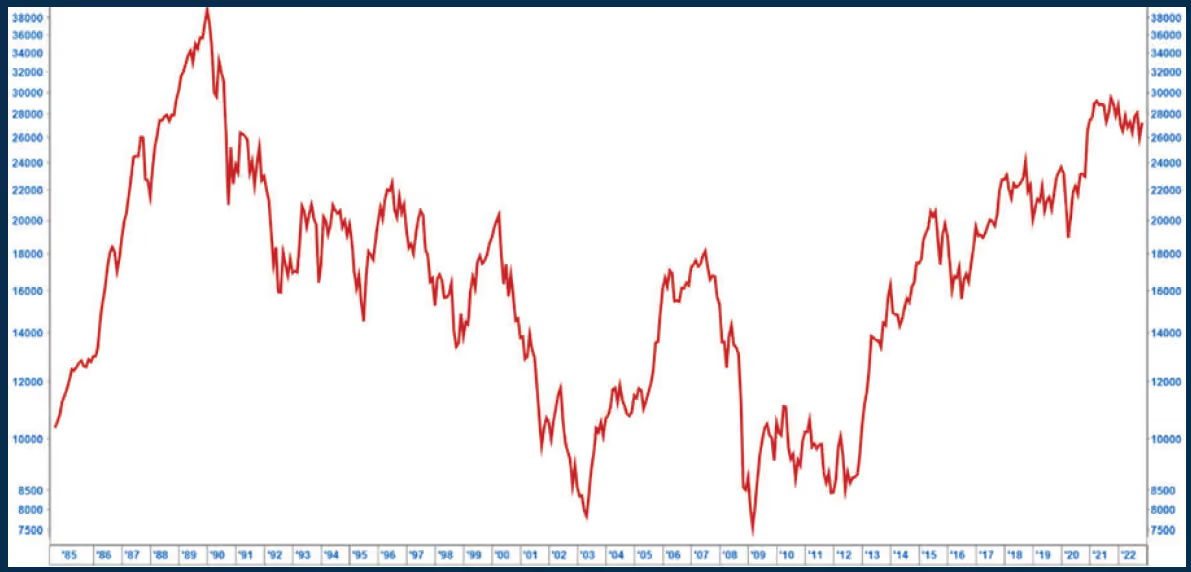
Source /ress - Month/y 51/08/1984 to 51/10/2022
In the 1980’s, Japanese shares were the popular trade. It was conventional wisdom that the Japanese economy was always going to rise. From a level of 101.91 at the end of 1950, the Nikkei 225 Index rose to a peak of 38 915.89 in December 1989, returning an impressive compound 12,9% p.a. in yen over the 39-year period. However, more than 32 years later, the Nikkei is still below that peak of December 1989.
After four decades of good growth on average for many major markets, driven by lower interest rates, we could see the equivalent of what the Japanese market experienced. We obviously do not know for sure. For many investors, it may be appropriate to consider a lower risk portfolio, such as the PPS Defensive Fund, which invests in all major asset classes and considers both risk and return and manages the balance over time.
Fund positioning
We believe that at over 11%, the yields on South African Government fixed rate bonds compensate for short-term risk. Even with inflation at over 7%, there is a real yield of 4%. The South African Reserve Bank (SARB) has taken a textbook approach to controlling inflation, and we believe that once the shocks of rising energy prices and supply chain disruptions are over, we should see a gradual decline in our inflation rate back into the target range.
We have a core of inflation-linked bonds in the portfolio, yielding inflation plus over 4% currently. Since the fund’s main objective is to deliver inflation plus 4% p.a. over the medium term, inflation-linkers help to achieve this goal. While the income yield on these assets may look low at 4%, the price of these bonds and the income will increase by the inflation rate. We have kept the exposure to domestic equities effectively below average at 20% but would look to increase this at the appropriate time. In our equity portfolio, we seek out companies with solid fundamentals.
At present, the average dividend yield forward on our equities is over 8%, providing some downside protection. We prefer assets with good yields, as yield is a less risky source of return than capital appreciation. This is reflected in the expected cash income on the portfolio of 6%. Cash is usually not a great place to hide with rising inflation. Just ask those who lived through the high inflation of the 1970’s or Germany in the 1930’s.